Kilimanjaro is deceptive: technically it is a trek, yet 5,895 metres is serious altitude that turns back marathon runners too. Three things decide success here: the season, the length of the route and your endurance.
At the equator there is no winter or summer — only dry and wet seasons. Two climbing windows: January to early March and June to October.
January–March is warmer, the summit snow is fresher, sunrises are clearer and there are slightly fewer people. That is exactly why our departure is in February. June–October is cooler and drier, but it is high season: the classic routes get crowded.
April–May and November are the rains: the trail in the forest belt turns to mud and the summit hides in cloud. You can go — but with less joy and lower odds.
The park sells routes from 5 days, and the statistics are merciless: on short programs roughly half of the climbers reach the top. The reason is simple — altitude is gained faster than the body can adapt.
Our Machame program takes 9 days with a "climb high — sleep low" profile: the hike to Lava Tower (4,630 m) with the night lower down in Barranco is the classic acclimatization sawtooth. It noticeably raises your odds of standing at Uhuru Peak instead of turning around at the crater rim.
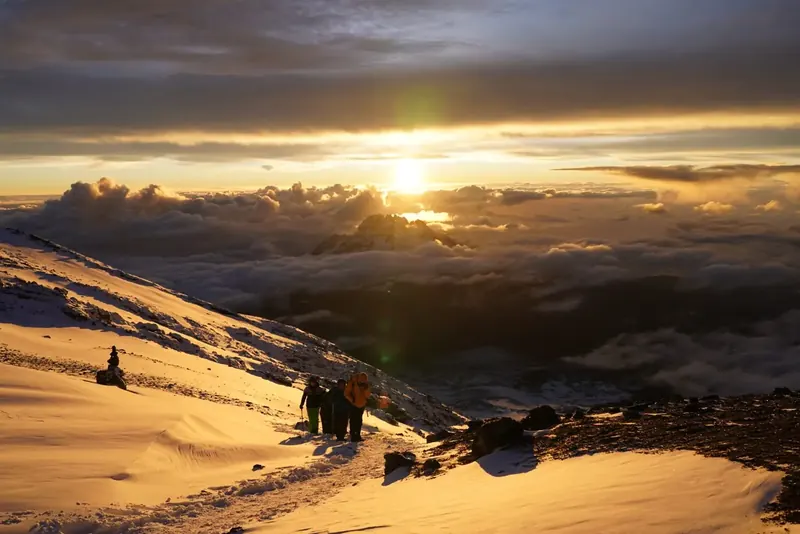
Summit night means climbing from 4,600 to 5,895 in 6–8 hours and a long descent the same day. Train as you would for Elbrus: 2–3 months of cardio and long walks — the week-by-week plan in our preparation article works for Kilimanjaro too.
Kilimanjaro's advantage is that porters carry your gear: you walk with a daypack. Its catch is the heat of the forest belt and the dust of the plateau: dehydration catches up faster than cold does.
The program costs from $3,160 with a group of five or more. On top, allow for: flights to Kilimanjaro airport, the $50 Tanzanian visa, insurance with helicopter evacuation, gear rental if needed, and tips for the crew — $400 per person, effectively obligatory by local custom.
Optional — a Ngorongoro safari after the mountain, from $1,500: two days, the Big Five and a Maasai village. Most of our participants call it the best "rest day" after the summit.
Do I need crampons and an ice axe? No. At most trekking poles and a warm down jacket for summit night: it can be −15° up there.
Is there phone signal on the route? In places; most camps have none — warn your family in advance.
From what age? The park allows 10+, but we recommend 16+ — and only with trekking experience.
The full itinerary, gear list and dates are on the Kilimanjaro climb page. Choosing between Kili and Elbrus — read our first-summit breakdown.
Tell us about your experience — we'll match a program and help with training, gear and tickets.
Leave a request Ask the bot in Telegram